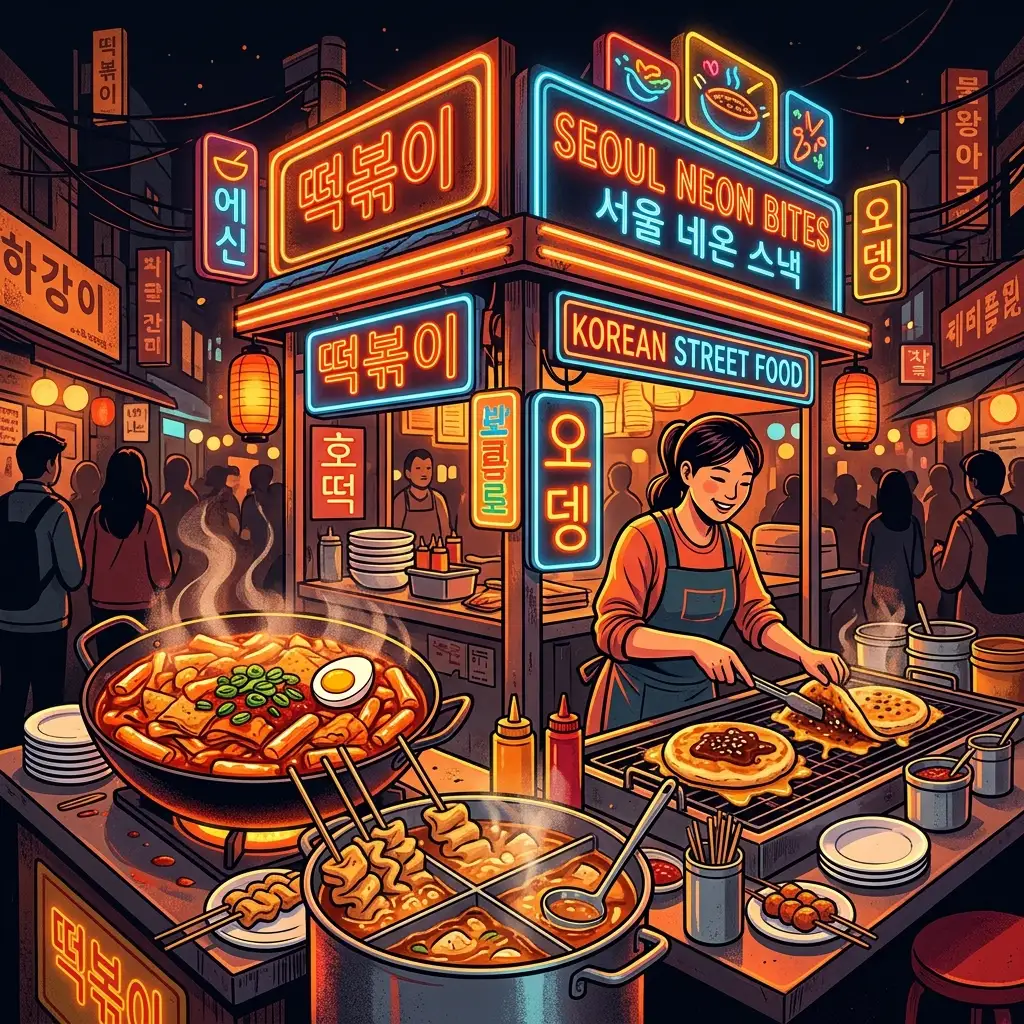
Seoul after dark isn’t just a city; it’s a sensory overload in the best possible way. One moment you’re staring at the sterile, glass facade of a corporate skyscraper, and the next, you’ve turned a corner into a narrow alley where steam billows from oversized metal vats and the scent of toasted sesame oil hangs heavy in the air. This is where the real soul of Korea lives. It’s found in the rhythmic clinking of metal spatulas against griddles and the low hum of crowds gathered around glowing stalls. For many, the sheer variety of options is daunting. For the seasoned traveler, it’s a playground.
Street food here is less about a quick snack and more about a social ritual. Whether it’s a hurried bite between shopping sprees in Myeongdong or a slow, contemplative evening at a traditional market, these foods tell a story of survival, innovation, and deep-rooted comfort. The landscape has shifted over the years—transitioning from survivalist carts to Instagrammable delicacies—but the core essence remains the same: bold flavors, surprising textures, and an unwavering commitment to warmth.
I’ve spent years wandering these markets, often venturing far beyond the English-language brochures to find the stalls where the queues are longest and the menus are nonexistent. I’ve learned that the secret to a great culinary tour isn’t just knowing what to eat, but knowing how to eat it. This guide is designed to move you past the surface level. We aren’t just looking for “popular” food; we’re looking for the authentic pulse of the city, ensuring you walk into any market with the confidence of a local who knows exactly where the best broth is hiding.
📍 Your Culinary Roadmap
- Beyond the Neon — The evolution and cultural weight of street dining
- The Savory Heavyweights — Breaking down Tteokbokki, Odeng, and Sundae
- Golden Treats — The best in sweet griddles and crispy fried bites
- Tasting Comparison — A quick-glance guide to spice, texture, and cost
- The Unwritten Rules — Pro tips on payments, manners, and location scouting
- The Traveler’s Toolkit — Solving dietary limits and language gaps
1. Beyond the Neon: Where the Sizzle Meets History
To understand why a simple plate of spicy rice cakes can evoke such strong emotion in Koreans, you have to look back at the post-war era. Following the Korean War, the country was in a state of frantic reconstruction. People were working long hours in industrial hubs, and they needed calories—fast, cheap, and filling. Street vendors filled this void. They weren’t just selling food; they were providing the fuel for a nation’s economic miracle. This legacy is why so much of the classic street food is carbohydrate-heavy and deeply savory. It was designed to sustain a worker through a twelve-hour shift.
Then came the Pojangmacha. These iconic orange tents became the neighborhood’s living room. In a society with rigid social hierarchies, the Pojangmacha was a Great Equalizer. Under that plastic tarp, a corporate CEO and a construction worker could sit on the same plastic stool, drink soju, and eat the same skewers. While the city’s modernization has pushed many of these tents into designated “food zones,” the spirit of the Pojangmacha persists. It’s a feeling of intimacy and warmth that you won’t find in a Michelin-starred restaurant.
Today, we see a fascinating collision of eras. You’ll find a vendor using a recipe passed down through three generations sitting right next to a stall selling “tornado potatoes” or cheese-filled lobster tails. This duality is what makes the current scene so electric. It’s a living museum of taste, where tradition doesn’t just survive—it evolves.
2. The Savory Heavyweights: The Core Essentials
If you’re new to the scene, start here. These three dishes are the bedrock of Korean street eating. You’ll find them in almost every cluster of stalls, usually simmering in massive, open-air trays that act as a beacon for hungry passersby.
Tteokbokki (The Fiery Rice Cake)
Tteokbokki is a masterclass in texture. These chewy, cylindrical rice cakes are simmered in a thick, glossy sauce that hits three notes simultaneously: spicy, sweet, and savory. The base is a combination of gochujang (fermented chili paste) and gochugaru (chili flakes). It’s not just about the heat, though. The slow simmering allows the starch from the rice cakes to thicken the sauce, creating a rich glaze that clings to everything. Pro tip: look for stalls that add plenty of sliced fish cakes and a hard-boiled egg; the yolk acts as a perfect buffer against the spice.
Odeng / Eomuk (The Comforting Fish Cake)
If Tteokbokki is the fire, Odeng is the water. These are folded sheets of fish cake threaded onto skewers and steeped in a light, clear broth. The broth is the real star here—a delicate infusion of dried anchovies, kelp, and radish. In the dead of winter, there is nothing more therapeutic than standing in the cold, clutching a paper cup of this steaming broth. Most vendors let you drink the broth for free as long as you buy a skewer. It’s a small gesture that makes the experience feel welcoming and communal.
Sundae (The Traditional Blood Sausage)
Sundae often intimidates first-timers, but it’s a mistake to let the ingredients deter you. This is a steamed sausage made from cow or pig intestines stuffed with glass noodles (dangmyeon), barley, and blood. Forget what you know about Western sausages; Sundae is mild, earthy, and has a satisfying, springy chew. It’s usually served with slices of steamed liver. The secret move? Dip your Sundae directly into the leftover Tteokbokki sauce. The spicy, sweet glaze cuts through the richness of the sausage perfectly.
3. Golden Treats: The Art of the Griddle
Once the spice has peaked, it’s time to pivot to the sweeter side of the street. The “dessert” stalls often use heavy iron presses and bubbling oil to create snacks that are as much about the sound (the crunch) as they are about the taste.
Hotteok (The Molten Pancake)
Hotteok is a winter essential. Imagine a yeast-based dough filled with a mixture of brown sugar, cinnamon, and crushed nuts. The vendor drops a ball of dough onto a greased griddle and presses it flat with a heavy circular iron. As the exterior crisps into a golden brown, the sugar inside melts into a bubbling, molten syrup. Warning: the center is incredibly hot. Take a small bite first to let the steam escape. If you find yourself in Busan, seek out Ssiat Hotteok, where the pancake is sliced open and stuffed with a mountain of toasted sunflower and pumpkin seeds.
Gyeran-ppang (Egg Bread)
This is essentially a savory-sweet muffin. A thick, fluffy batter is poured into an oblong mold, and a whole egg is cracked right on top. It’s baked until the edges are caramelized and the egg is just set. The result is a comforting contrast—the sweetness of the bread meeting the richness of the egg yolk. It’s the kind of snack that feels like a hug in food form, especially when eaten while walking through a crisp autumn afternoon in Seoul.
Dakgangjeong (Glazed Fried Chicken)
Korea’s obsession with fried chicken extends to the streets. Dakgangjeong consists of bite-sized chicken pieces that are double-fried for maximum crunch and then tossed in a sticky, sweet-and-sour glaze. Unlike regular fried chicken, this version is designed to be eaten cold or at room temperature, making it the perfect strolling snack. It’s usually garnished with crushed peanuts and small pieces of fried rice cake, giving you a variety of textures in every single mouthful.
4. Tasting Comparison: Finding Your Balance
Not every palate can handle a full-throttle spice attack. To help you curate your tasting tour, I’ve mapped out the most common items based on their flavor profiles and intensity. Use this as a guide to balance your order—pair a “High” spice item with a “Mild” sweet treat to keep your taste buds from burning out.
| Dish Name (English) | Korean Name | Key Ingredients | Spice Level | Price Range (KRW) |
|---|---|---|---|---|
| Tteokbokki | 떡볶이 | Rice cakes, fish cakes, gochujang sauce | 🌶️🌶️🌶️ Medium-High | 3,000 – 5,000 |
| Odeng | 오뎅 / 어묵 | Fish paste, anchovy kelp broth | ⚪ Mild / None | 1,000 – 2,000 per skewer |
| Sundae | 순대 | Glass noodles, pig’s blood, salt | ⚪ Mild / None | 4,000 – 6,000 |
| Hotteok | 호떡 | Yeast dough, brown sugar, cinnamon, nuts | ⚪ Sweet / None | 2,000 – 3,000 |
| Gyeran-ppang | 계란빵 | Whole egg, sweet cake batter | ⚪ Savory / None | 2,000 – 3,000 |
| Dakgangjeong | 닭강정 | Fried chicken, sweet chili glaze, peanuts | 🌶️ Low-Medium | 5,000 – 10,000 (cup/box) |
5. The Unwritten Rules: Eating Like a Pro
There’s a certain etiquette to street food that isn’t written on any sign but is observed by every local. Mastering these small details will make your experience smoother and earn you a few nods of respect from the vendors.
The Payment Dance: Cash is Still King
Korea is a digital powerhouse, but the street stalls are a different world. While tourist-heavy areas like Myeongdong are increasingly adopting cards, the best, most authentic stalls often operate on a cash-only basis. Carry a handful of 1,000 and 5,000 KRW notes. If you see a bank account number scribbled on a piece of cardboard, that’s for locals to do a quick mobile transfer. If you don’t have a Korean bank account, stick to cash. It’s faster, simpler, and always appreciated by the owners.
Hygiene and the “Stall Etiquette”
You’ll notice that street food in Korea is remarkably clean. The turnover is so high that ingredients rarely sit for long. When eating, remember that space is a premium. Stand close to the counter, enjoy your food, and then move along to make room for the next person. Most importantly, never walk away with your skewers. Return them to the designated bins at the stall. Navigating a crowded market with a sharp wooden stick in your hand is a recipe for disaster.
Where to Go: The Three Tiers of Markets
Depending on what you’re looking for, choose your destination wisely:
- The Traditional Powerhouse: Gwangjang Market. This is the place for authenticity. Go here for bindaetteok (mung bean pancakes) and a glimpse into the city’s old-world charm.
- The Trendy Hub: Myeongdong Night Market. It’s touristy, yes, but it’s also where the most creative “fusion” street foods appear. Think grilled lobster or cheese-covered everything.
- The Local Secret: Mangwon Market. If you want to see where actual Seoul residents shop for their dinner, this is it. It’s more relaxed, more affordable, and deeply authentic.
6. The Traveler’s Toolkit: Common Hurdles
Even with a guide, things can get confusing when you’re staring at a bubbling vat of something red and the vendor is speaking rapidly in Korean. Here are the most common “troubleshooting” scenarios.
Q1: I have allergies (peanuts/pork). How do I communicate this safely?
A: Many snacks use peanuts as a garnish or pork as a base (especially in Sundae). Don’t rely on hand gestures alone. Use a translation app or a printed card. Show the phrase “땅콩 알레르기가 있어요” (I have a peanut allergy) or “돼지고기를 못 먹어요” (I cannot eat pork). Most vendors are incredibly accommodating once they see a clear written request.
Q2: Where on earth do I throw away my trash? There are no bins!
A: This is the most common frustration for visitors. Seoul has very few public trash cans. The rule is simple: take your trash back to the stall where you bought the food. Every vendor has a disposal bag. If you’ve already walked a block away, hold onto your trash until you find a convenience store or a subway station.
Q3: I don’t speak Korean. How do I order without feeling awkward?
A: You don’t need fluent Korean to eat well. A polite smile and a point toward the food you want is 90% of the battle. Use your fingers to indicate the quantity. If you want to be extra polite, say “이거 하나 주세요” (i-geo ha-na ju-se-yo), which means “One of this, please.” It’s a simple phrase that goes a long way in building rapport.
Finding the Rhythm of the Street
Eating your way through South Korea is more than just a culinary exercise; it’s a way of connecting with the city’s heartbeat. There is something profoundly human about standing shoulder-to-shoulder with a stranger, sharing the warmth of a steaming fish cake broth while the neon lights of Seoul flicker above you. It’s in these unscripted moments—the accidental spice-induced tears, the discovery of a hidden alleyway, the kindness of a vendor—that you truly find the essence of the culture.
So, put away the rigid itinerary for a night. Follow your nose. Look for the longest line of locals, embrace the chaos of the market, and let your curiosity lead the way. Whether you’re diving into a plate of fiery Tteokbokki or savoring the molten sugar of a Hotteok, you’re not just eating street food—you’re tasting the history, the struggle, and the triumph of the Land of the Morning Calm.
TRAVEL WRITER
✓ Verified
Updated 2026.05