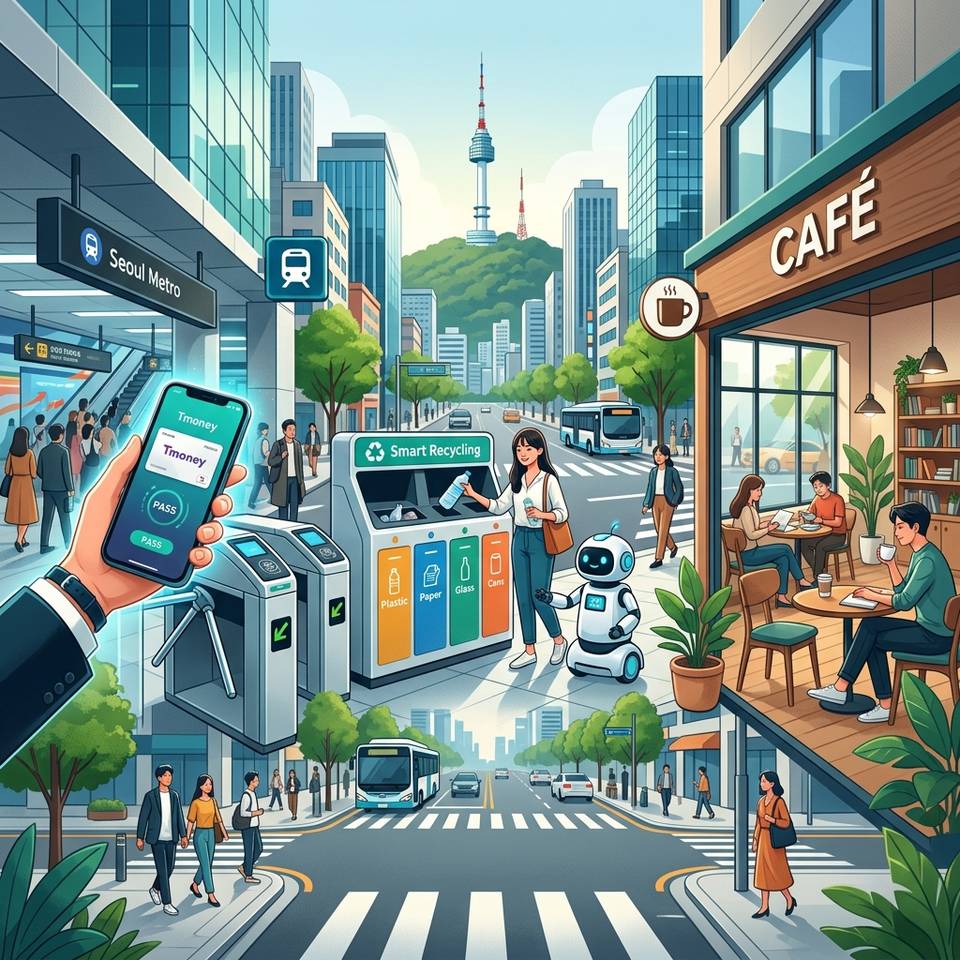

The Art of the Commute: Mastering the Transit Maze
Most visitors start with a physical T-Money card. It’s the reliable old guard of Korean transit. But standing in a 7-Eleven line to top up a plastic card with cash is a slow way to live in the world’s most connected city. The real efficiency gain comes from digitizing your movement. Modern Seoul is moving toward a cashless, app-integrated ecosystem where your phone is your ticket, your wallet, and your navigator.
💡 Insider Tip: The Climate Card (기후동행카드)
If your stay exceeds a week, the Climate Card is a game-changer. Launched to reduce carbon emissions, this pass offers unlimited rides on Seoul’s subways, buses, and the Ttareungyi public bike system for a flat monthly fee. It effectively removes the “fare anxiety” of exploring distant neighborhoods like Seongsu-dong or Euljiro, often slashing commuting costs by nearly half for active explorers.
There is one non-negotiable rule: always tap off. It seems trivial until you realize that failing to tag out triggers a penalty fare on your next trip. It’s an automated system with no room for “I forgot.” On the bright side, the transfer system is a marvel of urban planning. You can switch from a subway line to a local bus within 30 minutes (extending to an hour during late-night windows) without paying an additional base fare. Just keep your card active and follow the flow of the crowd.
Reading the Room: The Unwritten Rules of Korean Society
Korean social dynamics are governed by Nunchi (눈치)—the subtle art of sensing another person’s mood and reading the room. It is rooted in a Neo-Confucian legacy that prizes harmony over individual expression. While Koreans are generally forgiving of foreigners, showing an understanding of basic hierarchy and respect opens doors that no amount of money can buy. It’s about the small gestures.
Cultural Calibration: Western vs. Korean Norms
| Scenario | Western Standard | Korean Social Etiquette (Strict) | The Expat Hack |
|---|---|---|---|
| Passing Items | One-handed pass is normal. | Two hands must be used for respect. | Support your right forearm with your left hand when paying or pouring drinks. |
| Dining Start | Eat when served or ready. | Wait for the eldest person to lift their spoon first. | Keep hands folded politely until the eldest signals the start of the meal. |
| Tipping Culture | Expected (15% to 20%). | Strictly prohibited (considered offensive). | Never leave extra cash on tables. Exceptional service is met with a polite bow. |
| Drinking Etiquette | Drink facing the table. | Turn head away from elders when sipping. | Slightly pivot your torso and shield your cup with your hand while drinking. |
Public spaces in Korea operate on a principle of collective quiet. You’ll notice the subway cars are often eerily silent despite being packed. This isn’t because people are unhappy; it’s a social contract to minimize disturbance. Loud phone conversations or boisterous groups are viewed as a breach of this peace. Set your phone to “manner mode” and keep your voice low. When handing over a credit card or receiving a business card, use both hands. This simple physical shift signals a level of respect that is deeply appreciated in professional and formal settings.
The Digital Lifeline: Essential Apps for Survival
Here is a harsh truth: Google Maps is essentially a paperweight in South Korea. Due to longstanding national security laws regarding the export of precise mapping data, Google’s local functionality is severely limited. If you rely on it, you will likely find yourself walking in circles in a narrow alleyway in Myeongdong. To survive, you need a localized digital toolkit.
The Garbage Gauntlet: Decoding Jongnyangje
If there is one thing that humbles every expat, it is the Korean waste disposal system, or Jongnyangje (종량제). This isn’t just “recycling”; it is a highly regulated civic duty. You cannot use generic plastic bags. You must buy official, government-branded bags from local convenience stores. Using the wrong bag can lead to your trash being left on the curb with a warning sticker—or in worse cases, a significant fine.
⚠️ The “Animal Feed” Logic for Food Waste
The golden rule for food waste (Eum-sik-mul Sseu-re-gi) is simple: If an animal could potentially eat it, it’s food waste. This sounds intuitive until you hit the exceptions. Eggshells, chicken bones, shellfish shells, and hard nut shells are general waste. Why? Because food waste is processed into animal feed, and these hard items can injure livestock.
Geography also matters. Trash bags are district-specific. A bag bought in Mapo-gu is invalid in Gangnam-gu. If you move, you’ll need to buy new bags for your new neighborhood. For recyclables, the rule is “wash, dry, and separate.” Plastic bottles must have their labels removed, and cardboard boxes must be flattened. In many apartment complexes, “trash managers” (often elderly residents) keep a watchful eye; a few friendly bows and a correctly sorted bin will make you their favorite neighbor.
Final Check: Common Hurdles & Solutions
Integrating into life in Korea is a process of trial and error. While the digital side is seamless, the human side requires patience and observation. To wrap things up, we’ve addressed the most common points of confusion for those transitioning to the Peninsula.
Can I rely entirely on credit cards?
Mostly, yes. Korea is nearly cashless. However, traditional markets (Sijang) and some tiny “hole-in-the-wall” eateries still prefer cash. Carrying 20,000 to 30,000 Won in small bills is a smart move for those authentic street food experiences.
What happens if I lose my T-Money card?
If it was an anonymous card, the balance is unfortunately gone. This is the primary reason to switch to a registered mobile T-Money card or the Climate Card. Digital accounts can be recovered; plastic cards cannot.
How do I handle a medical or police emergency?
Dial 112 for police or 119 for fire and ambulance. Both services have integrated translation systems. As soon as the operator answers, clearly say “English” or your native language. They will bring a professional interpreter onto the line in seconds.
Verified Authoritative Source
TRAVEL WRITER
✓ Verified
Updated 2026.05