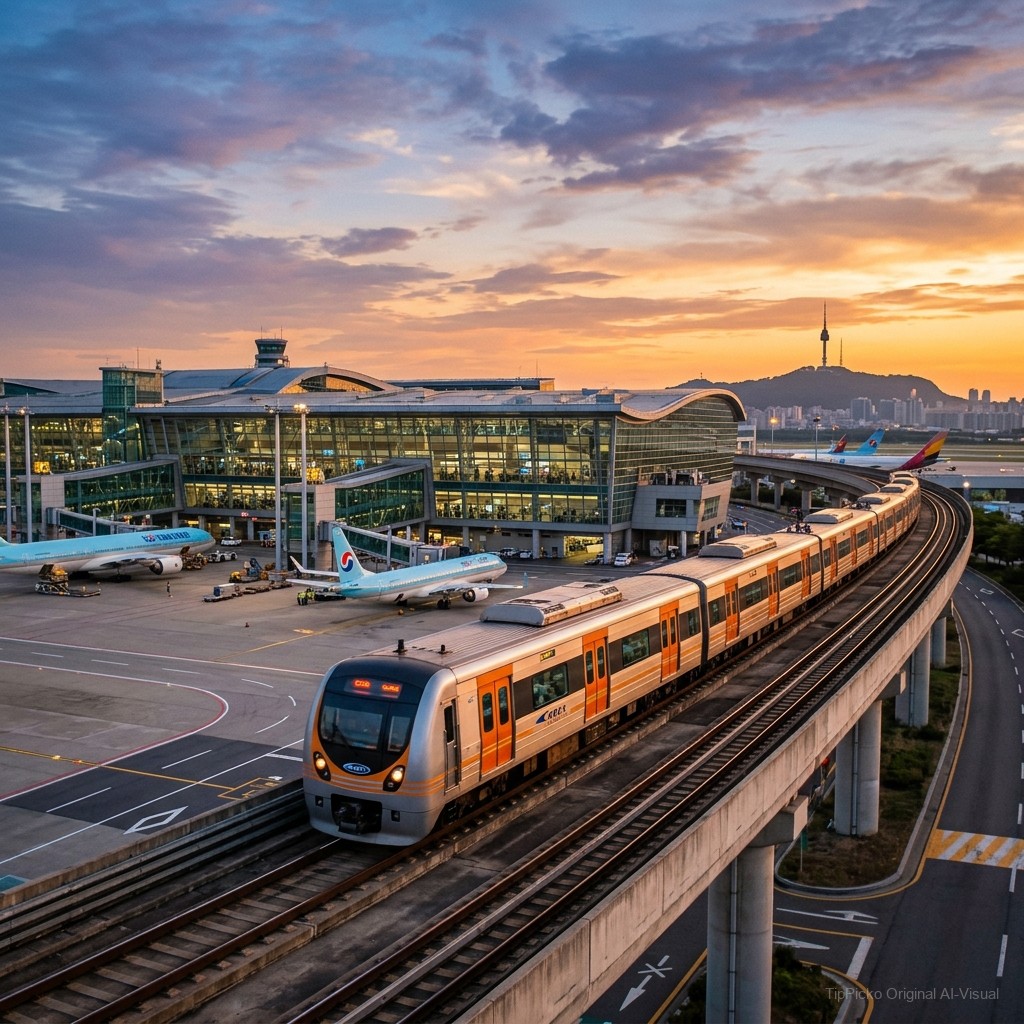
Incheon Airport to Seoul:
The Complete Transport Guide
AREX, Airport Bus, or Taxi? We break down the best ways to reach the city based on your luggage, budget, and arrival time.
Start your trip without the stress.
💡 Quick Decision Matrix
AREX Express: The fastest route (43 min). Ideal for those staying near Seoul Station or Myeongdong.
AREX All-Stop: Budget-friendly (₩4,750). The smartest choice for Hongdae or Mapo neighborhoods.
Limousine Buses: Maximum comfort. Best for heavy luggage and direct access to major hotels in Gangnam or Itaewon.
Landing at Incheon International Airport (ICN) is often a whirlwind experience. The terminal is a marvel of modern architecture, but its scale can be intimidating when you’re exhausted from a long-haul flight. Because the airport sits on Yeongjong Island, you aren’t just taking a quick trip to the city; you’re crossing a bridge into the heart of one of Asia’s most dynamic metropolises.
The journey to Seoul typically takes between 43 and 90 minutes. While that sounds straightforward, the “best” way to get there depends entirely on your specific circumstances. Are you traveling with three oversized suitcases? Do you have a group of four people? Or are you a solo backpacker on a strict budget? Making the wrong choice can lead to an hour of hauling bags up subway stairs or getting stuck in Seoul’s notorious rush-hour traffic.
The Big Picture: Finding Your Ideal Route
Transport in Seoul is world-class, but it requires a bit of strategy. You generally have to balance three factors: speed, cost, and physical effort. While the trains are punctual and fast, they require more walking. The buses are relaxing but vulnerable to traffic. Taxis offer door-to-door service but can become pricey for solo travelers.
📊 Transport Comparison 2026
| Transport Option | Travel Time | Cost (approx.) | Best For… |
|---|---|---|---|
| AREX Express | 43–51 min | ₩13,000 (~$9.50) | Speed & Comfort. |
| AREX All-Stop | ~60 min | ₩4,150–4,750 (~$3) | Budget & Hongdae Area. |
| Airport Bus | 60–90 min | ₩16,000–18,000 (~$13) | Heavy Luggage & Door-to-Door. |
| Taxi / KakaoT | 50–90 min | ₩60,000–100,000+ | Families, Groups of 3-4, Late Arrivals. |
The High-Speed Corridor: AREX Express
For those who value time above all else, the Airport Railroad Express (AREX) is the gold standard. This is a dedicated, non-stop service that whisks you from the airport to Seoul Station with surgical precision. There are no intermediate stops to worry about and no unexpected delays.
- Route: ICN T2 → ICN T1 → Seoul Station (Direct)
- Transit Time: 43 min from T1 / 51 min from T2
- Price Point: ₩13,000 per adult
- Onboard Experience: Reserved seating, dedicated luggage racks, and reliable Wi-Fi
If your hotel is in Myeongdong or near the city center, this is likely your best bet. Once you arrive at Seoul Station, you can easily transition to a taxi or the local subway. It is the most predictable option.
To save a bit of money, consider booking your tickets through platforms like Klook or KKday. They often provide a 10–20% discount compared to the station kiosks. One critical detail: the Express train requires a specific ticket. You cannot simply tap your T-Money card at the gate for this service; it is a reserved-seat system.
The Local’s Path: AREX All-Stop Train
Not everyone needs a non-stop sprint to the center. If you’re staying in the trendy streets of Hongdae or the business hubs of Mapo, the All-Stop train is far more practical. It’s essentially a commuter rail that serves several key hubs before reaching the terminus.
- Strategic Stops: Hongik University (Hongdae), Gongdeok, and Seoul Station
- Affordability: ₩4,150–4,750 (T-Money compatible)
- Duration: Roughly 60 minutes to reach the city center
- Frequency: Trains run every 10–15 minutes
The experience here is different. There are no reserved seats, and it feels like a standard metro ride. This is a great way to save money, but it comes with a risk. If you land during the morning rush (8:00 AM – 9:00 AM) or the evening peak (6:00 PM – 7:00 PM), you might find yourself standing in a crowded carriage with your luggage. If you’re traveling during off-peak hours, it’s a comfortable and efficient ride.
Door-to-Door Luxury: The Limousine Bus
Seoul’s subway system is legendary, but it’s also full of stairs, transfers, and long corridors. For travelers with heavy suitcases or those who simply cannot face another walk after a 12-hour flight, the Airport Limousine Bus is a godsend.
These aren’t your typical city buses. They feature wide, reclining leather seats and ample under-carriage storage. The driver takes care of your luggage, and the bus drops you off at major hotels or key district hubs in Gangnam, Itaewon, and Jamsil. You can simply sit back and watch the city skyline emerge as you approach your destination.
- Pricing: ₩16,000–18,000 per person
- Timing: 60–90 minutes (Highly variable based on traffic)
- Late-Night Access: Routes N6000 and N6001 operate as night owls for those arriving after midnight.
Private Transit: Taxis and the KakaoT Ecosystem
Taxis are often viewed as a luxury, but for groups of three or four, they are frequently the most economical choice. Consider this: four limousine bus tickets cost roughly ₩72,000. A taxi to the Hongdae area often costs between ₩50,000 and ₩65,000. You get a private ride directly to your hotel door for less than the cost of the bus.
- Hongdae / Mapo: ₩50,000–65,000
- Myeongdong / City Hall: ₩55,000–75,000
- Gangnam / COEX: ₩75,000–100,000+
One important caveat: be mindful of the late-night surcharge. Between midnight and 4:00 AM, a 30% fee is added to the fare. To avoid language barriers and ensure a fair price, download the KakaoT app. It’s the Korean equivalent of Uber; you can set your destination in English and see an estimated fare before the car even arrives.
❓ Essential Arrival FAQs
Not at all. While the AREX trains stop running around 11:50 PM, you have several options. The Night Limousine Buses (N6000/N6001) are reliable, and taxis operate 24/7. Just be prepared for the midnight surcharge if you choose a cab.
Unfortunately, no. The subway gates and buses require a physical T-Money card. You can buy one at any convenience store (CU, GS25, 7-Eleven) in the arrivals hall. You must top it up with cash (Korean Won), so keep some bills handy.
In short: no. Due to government security regulations, Google Maps doesn’t provide full walking or driving navigation in Korea. Download Naver Map or KakaoMap. Both have English interfaces and provide precise, real-time data that Google simply cannot match.
If you’re nervous about navigating, stick with the AREX trains. The English signage is incredibly clear, there’s zero traffic risk, and the process from the plane to the platform is very intuitive.
Final Verdict: Which One Should You Choose?
There is no single “best” way to get from Incheon to Seoul—only the best way for *your* specific trip. If you’re a solo traveler with a small carry-on and a budget to maintain, the All-Stop train is your best friend. If you’ve arrived with a family and three massive suitcases, don’t fight the subway stairs; book a taxi or hop on the Limousine Bus.
The transition from the airport to the city sets the tone for your entire vacation. Take a breath, grab your T-Money card, and choose the route that lets you arrive in Seoul feeling refreshed rather than exhausted.
Editor’s Pro Tip
While the AREX Express is remarkably fast, remember that Seoul Station is a massive complex. If your hotel is a 15-minute walk from the station, you might spend as much time navigating the station as you did on the train. In these cases, the Airport Limousine bus—which often drops passengers directly at hotel lobbies—is actually the faster “door-to-door” choice.